Buy Online or Call: (800) 648-7239
High Quality Rechargeable Batteries, Battery Chargers, Flashlights, And Mobile Energy Products

Sign up to our newsletter:


Horizon Battery
1310 Delsea Dr MBV 2
Deptford,NJ 08096
1-800-648-7239
Horizon Battery is upfront Privacy Policy by TRUSTe
Bookmark and Share

Tenergy 9V Battery Charger TN346 Review

May 15th, 2012

They say that necessity is the mother of all invention.  All I can say is that for the last few years I have been talking with battery charger manufacturers about the need for a higher capacity 9V Battery charger that could handle multiple chemistries – both NiMH and Li-Ion rechargeable batteries.

Finally somebody listened. The Tenergy Corp has just introduced an inexpensive, 6-bay 9V battery charger that will handle both NiMH and Li-Ion cells.  We had the opportunity to perform a “hands-on” product review of the Tenergy TN346 battery charger and see how it stood up to  the charging of Ansmann NiMH 9V cells as well as  HiTech and Tenergy Li-Ion Cells.  Take a few minutes to watch the product review.

We found the charger to perform well with both chemistries. The Ansmann NiMh’s charged up to capacity on the first charge.  Both the HiTech and Tenergy Li-Ion’s required 2 or 3 intital charge cycles to bring them up to full capacity. (This is typical of new batteries, particularly Li-Ion chemistry)

As to the batteries, the “new kid on the block” the Tenergy li-Ion 9V, (rated at 500 mah,)  we found the true capacity to be closer to 350 mah  (it’s stated minimum capacity.)

The best feature of the this new charger is when you have different devices that require a variety of run-times. You can opt for the higher capacity 9V’s in Li-Ion and still use it to charge the NiMH cells of lower capacity.

An example of this would be wireless mics or in-ear monitors. Suppose you have a few units that are real power hungry and require runtimes in excess of 4 hours. You could use a Li-Ion battery and get up to 15 hours and still use the NiMH cells for your shorter run time devices.  NiMH have higher recycles value than Li-Ions so you can still get the most mileage from them and use the high capacity Li-ions for your longer run-times – without the need for separate chargers — and the possibility of charging the wrong cells in the wrong charger.


High Quality Rechargeable Batteries

May 2nd, 2012

What constitutes a high quality rechargeable battery? This is not as simple as some may think.  As the public becomes more aware of the “green” value of rechargeable batteries, there is a growing list of new battery brands popping up.  It  reminds me of the “natural foods” phenomenon that occurred when the major food brands were challenged about the nutritional value of their products. Suddenly, every cereal, bread, snack, etc.,  starting touting the label “all natural.”

And so it goes with the rechargeable battery industry.

Here a few ways to tell if you’re getting  high quality rechargeable batteries:

  1. Check who’s using them.  The professionals that rely on high quality rechargeables have been using the best brands for quite some time. They’ve already done the research by trial and error.  This is a good time to point out some of our high profile companies – like Cirque du Soleil, Blue Man Group, plus thousands of production facilities and professional photographers who all use the Ansmann batteries and chargers.  This should be a huge “hint.”
  2. Check the warranty.  Is there a performance guarantee outside the 30-day refund? (Some brands won’t even provide the 30 days!)  Professional grade rechargeable batteries will offer a two-year guarantee on the ability for a nimh rechargeable battery to hold a charge. That doesn’t mean that the battery will still be able to be charged to 100% capacity – as this will vary greatly by frequency of use and drain applied to the battery. The warranty has more to do about internal shorting of the battery and it’s ability to continue to be used for more recycles.
  3. Check the Label.  Just like everyone in the supermarket is reading the nutritional value of the foods they consume, your batteries should provide a bit of truth to “what’s inside.” Recently, the European Union forced battery manufacturers to provide the “minimum capacity” on the package of rechargeable batteries and on the battery itself.  (EU Battery Directive 2066/66/EC)   This is a step in the right direction as  you will now see the differences in what the stated “maximum capacity” is and the minimum capacity.  If it differs by more than 10%, you going to see a lot of “re-labeling” occur.  Some brands out there that have been purporting AA 2900 mah reflect a minimum capcity of 2400 mah or less!  Although this new labeling is not mandatory here in the US  (yet) the Ansmann brand is already providing both the maximum AND minimum capacities on their labels.

All though you’ve heard it before, I’ll say it again.  You get what you pay for. Competition is the battery field is fierce. This is good for consumers with one caveat: Always compare apples to apples.  In a slow economy, price is king – however – saving $1 on a 4-pack of batteries that you’ll need to replace 3-4x times sooner makes no sense at all.

Horizon Battery Introduces New 12-bay AA AAA Battery Charger

April 24th, 2012

We’re pleased to announce the addition of our 12-bay battery charger to our arsenal of quality AA and AAA chargers. This inexpensive automated charger works well with both Max E  low discharge batteries as well as Ansmann high capacity cells.

Horizon’s New 12-Bay AA-AAAA Battery Charger

This LCD Microprocessor controlled, 12 position battery charger boasts the follow features:

  • Suitable for 1-12 pieces of AA or AAA N-iMH Ni-Cad rechargeable batteries
  • Built-in IC and Advanced Delta-V charging control function
  • Individual monitoring/charging of cells
  • Overheat, over-current, and short-circuit protection
  • Detection of non-rechargeable and defective battery
  • LCD indicator for individual charging status
  • Manual discharge function
  • Auto-switch to trickle charge after charge cycle.

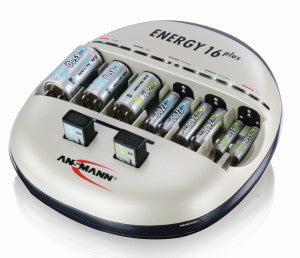
Introductory pricing is good through April 25th.  The charger can be bought separately or with a selection of Ansmann and Max E AA or AAA rechargeable batteries.  For those that prefer automated refreshing of cell, instead of manual discharge, we still recommend either the Energy 8+ or Energy 16 chargers.  Many clients use a combination of the reconditioning battery chargers and the new 12-bay “manual discharge” charger.

With a charge current of 500 mA per channel, the new 12-bay charger delivers freshly charged cells in a 2-6 hours range, depending on the cell’s capacity. The charger also carries a UL approved 100-240V US power supply which can be used worldwide.


Battery Chargers

April 3rd, 2012

Well folks, here’s the third part of the series on making the most of rechargeable batteries. In this segment we discuss the “heart” of your rechargeable system:  battery chargers.

You will learn the differences between refresh or reconditioning chargers, and what type of charger to use for the various types of batteries.

Pay attention to the recharging tips at the end of the video.  These simple tricks will help you get the most value for the rechargeable batteries you purchase and use.

We appreciate the feedback from our readers. Feel free to share this series with your friends, family and co-workers.  Happy recharging!

Rechargeable Batteries

March 29th, 2012

We’ve just posted Part II of  “Learning the How and Why – Before You Buy” video series – choosing the best rechargeable batteries for your applications.  In this section we deal with the differences between high-capacity rechargeable batteries, low discharge batteries, nimh and lithium batteries and discuss the strengths and weakness of each.

We encourage you to first view Part I before tackling this section. There are also some introductory savings coupons at the end of this video for first-time users of rechargeable batteries and high quality Ansmann battery chargers.

Fee free to share it with your friends, family and co-workers


Rechargeable Battery – Finding The Best Rechargeable Battery

March 27th, 2012

We’re continuing to expand consumer education of the effective use of the rechargeable battery in a new 3 part video series just released yesterday.  In Part I, we explore the differences between high drain and low drain devices as well as understanding run-time, pattern of use, and cost comparisons to alkaline batteries. We’ve also included a helpful link for a “Rechargeable Battery Checklist” which makes it very easy to categorize electronic devices for those who are looking to make the switch to rechargeables.

Although we’ve found that most people  make the switch to rechargeables do so by first using them for one device, this informative video explains how easy it is to convert your entire household, business or organization over to rechargeable batteries.  In Part II and III we explore the different types of rechargeable batteries and how to choose the best charger.  Feel free to pass it on to your family and friends.


Coin Cells, Button Cells and Hearing Aid Batteries At Horizon Battery

March 13th, 2012

Our inventory of specialty cells has grown to include the most common size coin cells, button cells and hearing aid batteries.  The Ansmann Brand guarantees freshness and high performance.  If you have a car remote, digital scale or other electronics then you know how important it is to stay stocked in the proper sizes of these specialty batteries.

Alkaline and Lithium Button Cells

Alkaline and Lithium Button Cells

We offer both alkaline and high-power lithium coin cells as well as zinc-air hearing aid  batteries in all standard sizes.  You’ll find our prices to be less than what you would pay in the hardware or DIY store down the street.

Next time you place an order for rechargeable batteries or battery chargers, be sure to include a few of these specialty batteries – this way you’ll get them shipped inexpensively.

Lithium Batteries Now Available at Horizon Battery

March 6th, 2012

We’ve added several types of primary batteries to our arsenal of products. The Ansmann Extreme Lithium Batteries are sure to be a winner for those who are looking for high quality lithium batteries. These batteries last 7X longer than standard alkaline batteries and are much lighter.  Another benefit is that our lithium batteries have a shelf life of over 10 years.

Lest you forget, we still advocate the use of rechargeable batteries whenever possible.  Over time, a rechargeable battery will still be the best money saving (and planet-saving) investment you can make.

So, when should you use a high-capacity lithium battery? We recommend using them for outdoors devices  – particularly those exposed to low temperatures. The new Ansmann lithium batteries have a use range of -40°C and +60°C.   Therefore, the Lithium Battery is excellent adapted for outdoor use such as weather stations, thermometers, etc.

For those of you that are not able to remember to change your smoke detector batteries every six months, then consider a lithium battery.  Remember, we still recommend you check your batteries every six months and use a low-self discharge rechargeable battery like the Max-E batteries.

Whether to use a primary lithium battery versus a rechargeable battery will always come back to price, convenience, and conscience.  To buy a battery charger will always cost a little more up front, but in the long haul, you’ll save big time.

The new AnAnsmann Lithium Batteriessmann Extreme lithium batteries are available in AAA, AA and 9V. The AA lithium batteries are available in either a 2 pk or 4 pk blister.  9V’s are available in a 1-pkblister and the AAA’s are available in a 2-pk blister.

Finally, you’ll love the pricing.  For years, Energizer and Duracell have been charging outrageous amounts for lithium batteries.  For example, you’ll find Energizer AA’s going for around $6.25 for a two-pack.

We offer Ansmann lithium AA’s 2-pk  for only $4.99  Our 9V’s and AAA’s are also comparable in price – so be sure to check them out.


Church Batteries – A Rechargeable Solution

February 14th, 2012

With over 25,000 churches using our rechargeable systems, church batteries should be a no-brainer. The days of stockpiling huge amounts of disposable are over. With Ansmann and Horizon award wimming rechargeable systems, each church we convert saves money, time and the planet – each and every year.

Although we are encouraged to see mega-churches make the switch to rechargeable batteries, it is our goal to convert every church, large or small to Ansmann rechargeable batteries for church. An average size church can easily save their battery budget times five years. Depending upon how active your music ministry is and the amount of wireless mics, many churches easily spend over $500 in year in throw-away batteries.

It really doesn’t require much math to figure out how much you can save –when you consider that each rechargeable battery for church can be used up to 1000 times with the proper battery charger. Realistically, for most churches this means you don;t buy batteries for about 5 or 6 years.

If you’ve ever considered making the switch, why not talk to us? We have the technology and know-how to provide you with a customized rechargeable system to replace all those throw-away church batteries that are piling up in your sound room.

For more information, click here.

High Capacity Rechargeable Batteries Are Still Preferred For Professional Use

February 14th, 2012

While there has been an onslaught of low discharge rechargeable batteries on the market over the last several years, most professional users of rechargeables still prefer high capacity rechargeable batteries.

Why? Two reasons.

First, most professionals are using their rechargeable batteries on a daily basis, so the need for batteries that have a long shelf life is not necessary. Most pro-users choose a good reconditioning charger like the Energy 8 Plus or Energy 16 battery charger and leave the batteries on the charger until ready for use. This assures the batteries are fully charged for maximum usage. With a low self discharge battery, there is always guess work as to how much remaining capacity exist in the battery, even when using a battery capacity tester.

Secondly, the high capacity rechargeable battery is exactly that – a higher capacity. Most low discharge batteries do not match capacity of the high capacity batteries. So, when a photogragpher is shooting, he/she wants the maximum amount of run-time available, which a the low self discharge battery cannot provide.

However, where the low self discharge battery shines is for the more occasional user — such as family use with game controllers, digital cameras, wireless mouse and keyboards, etc. The low discharge battery is truly the battery of choice in these instances.

Still not sure what battery to use? Let us help you. We have a free report and evaluation service regarding rechargeable batteries which you can find here on our website.


© 2012 Copyright Horizon Battery. All Rights Reserved. | We respect your privacy. | Sitemap

Privacy Policy by TRUSTe

SEO-Cart: Search Engine Friendly E-commerce Software